
Everyone deserves the opportunity to earn a living that can sustain a family and build security for future generations. United Way is working with our partners and community to close the gap between financial hardship and financial stability so that every family has an equal opportunity to thrive.
Community Standing
Regional and internal data sources show that more than 35% of Southeast Minnesota households are navigating financial challenges. While unemployment, wages, and rising costs all contribute to financial instability, housing stability remains a key concern.
ALICE: Asset Limited, Income Constrained, Employed
The ALICE Household Survival Budget
The ALICE Household Survival Budget represents the bare-minimum cost of essential needs—housing, child care, food, transportation, technology, and taxes—plus 10% for miscellaneous costs. Unlike the Federal Poverty Level (FPL) guidelines, the ALICE Survival Budget is calculated at the county level to reflect local cost-of-living differences.
The bare minimum household income necessary to live and work in Olmsted County for a household with two adults and two children (ages 0-5) is:
$90,804
*with no opportunity to build savings
|
Categories |
Cost per Month |
|---|---|
|
Housing |
$1,436 |
|
Child Care |
$1,646 |
|
Food |
$1,341 |
|
Transportation |
$942 |
|
Healthcare |
$686 |
|
Technology |
$116 |
|
Miscellaneous |
$617 |
|
Taxes |
$783 |
Use the ALICE Income Status Tool to find your county's household survival budget. You can adjust household members to reflect individual or family homes.
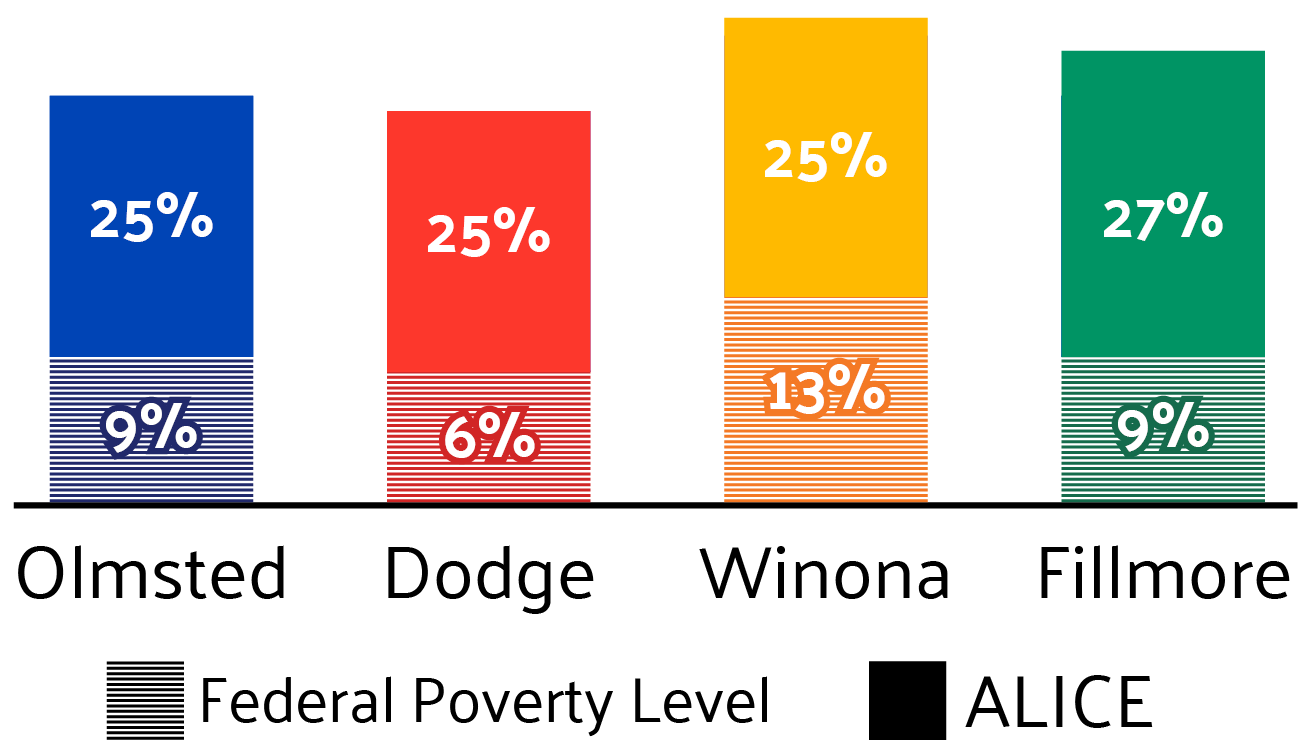
Across all Olmsted, Dodge, Winona, and Fillmore counties, at least 25% of residents are ALICE. In Southeast Minnesota, more than 1 in 3 households struggle to meet their basic needs, leaving many just one emergency away from financial instability.
What United Way is doing for Financial Security
Last year, United Way invested over $150,000 into housing stability partners, partnered with Volunteer Income Tax Assistance (VITA) for free tax prep, used 211 to connect families with housing and financial resources, and continued ALICE data work.
Some of the results of our Financial Security initiatives:
214
individuals stabilized their housing

148
evictions expunged

2,000+
referrals for housing, shelter, and other financial security resources through 211

272
families with increased disposable income
Full Report
Take a deeper dive into financial security challenges and opportunities in Southeast Minnesota.
last updated May 11, 2026 3:04 PM